
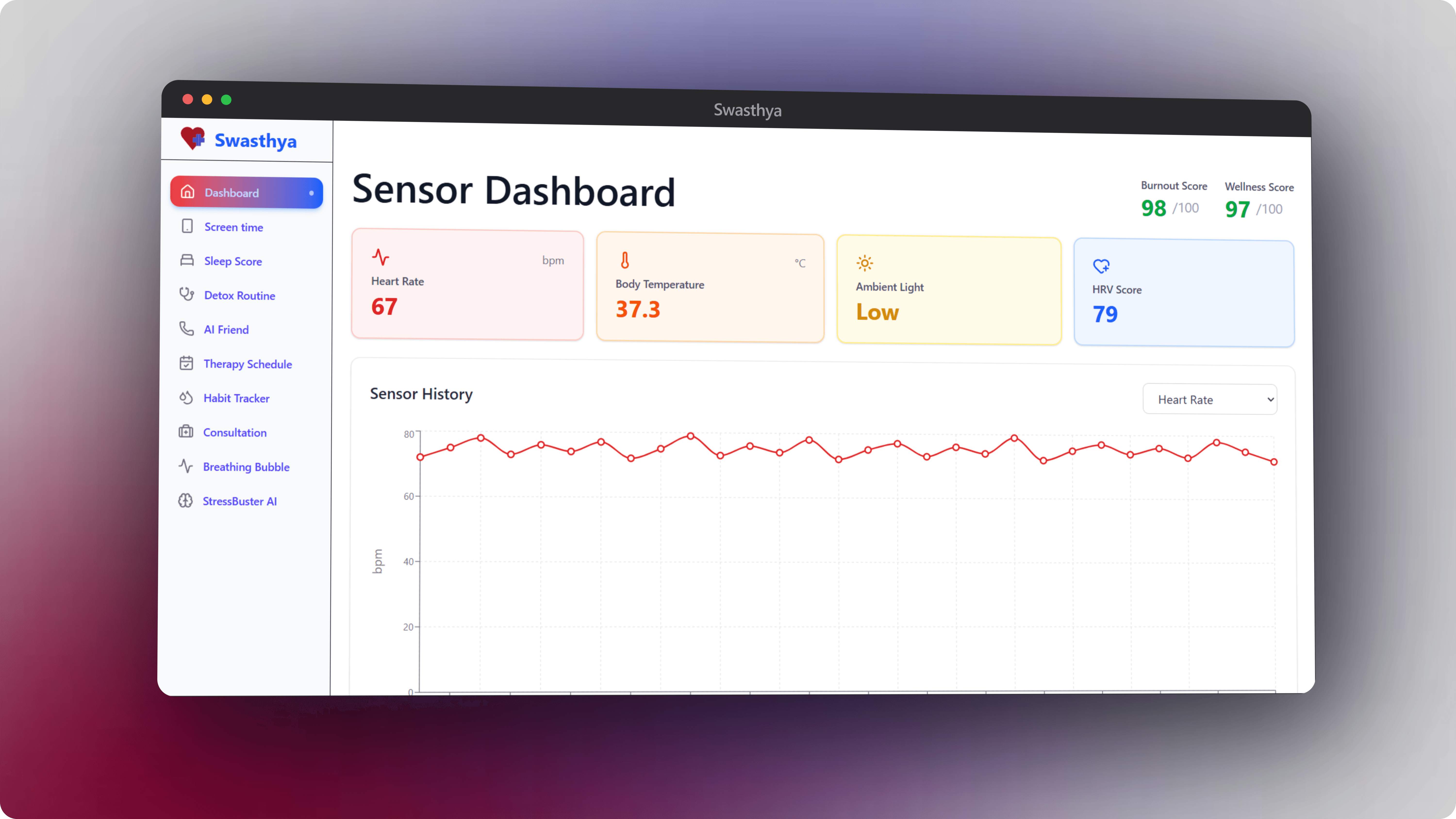
Swasthya
An AI-driven, non-invasive health monitoring platform for early fatigue and stress detection using ambient sensing, voice analytics, and edge AI.
Timeline
Hackathon Project
Role
Full Stack + AI Engineer
Team
Team Project (AI-Tronics)
Status
CompletedTechnology Stack
Key Challenges
- Non-invasive fatigue & stress detection
- Edge AI inference without cloud dependency
- Hardware sensor integration over WiFi
- Combining multi-modal signals into a single score
- Privacy-first system design
Key Learnings
- Edge AI and local inference systems
- Multi-modal data fusion
- AI-assisted healthcare product design
- Hardware–software integration
- Privacy-first architecture
Swasthya: AI-Driven Wellness Monitoring Platform
Overview
Swasthya is an AI-driven health monitoring platform designed to detect early signs of fatigue, stress, and burnout using non-invasive ambient sensing and voice analytics.
Unlike traditional health systems that rely on wearables or intrusive sensors, Swasthya uses environmental signals, short voice interactions, and edge AI to generate a real-time Wellness Index (0–100) — all while keeping user data private and locally processed.
What Users Can Do
- View Real-Time Wellness Index: Instantly understand fatigue and stress levels.
- Monitor Sensor Data: Track heart rate, temperature, ambient light, and sound levels.
- AI Breathing Exercises: Receive personalized breathing routines based on wellness score.
- Hydration Tracking: Monitor daily water intake with smart email reminders.
- AI Wellness Companion: Talk to an AI friend over phone calls for emotional support.
- Stress Detection: Analyze voice tone and facial expressions for mood and fatigue.
- Therapy Scheduling: Discover nearby mental health clinics and book appointments.
Why We Built This
Early fatigue and stress are often ignored until they turn serious, especially in:
- Workplaces
- Classrooms
- Rural or resource-constrained healthcare settings
Wearables aren’t always practical, affordable, or comfortable.
Swasthya was built to explore how AI + ambient sensing can act as a silent health companion, providing early warnings without invading privacy or requiring constant user effort.
Tech Stack
Frontend
- React + TypeScript – Interactive dashboard
- Tailwind CSS – Clean, accessible UI
- Recharts – Sensor data visualization
- Google Maps API – Therapy clinic discovery
- Clerk – Authentication
Backend
- Node.js + Express – API layer
- Prisma ORM – Database access
- PostgreSQL – Persistent storage
- Nodemailer – Email reminders
ML & AI
- Python ML Backend – Sensor & AI processing
- Lightweight AI Models – Voice & mood analysis
- Google Gemini AI – Personalized breathing exercises
- Vapi.ai – AI-powered phone calls
- Edge AI – Local inference without cloud dependency
Hardware
- Heart Rate Sensor
- Body Temperature Sensor
- Ambient Light Sensor
- Sound Sensor
(All connected via WiFi)
Key Technical Highlights
- Non-invasive health monitoring system
- Edge AI inference for privacy-first processing
- Multi-modal data fusion (sensor + voice + environment)
- Wellness Index generation (0–100 scale)
- Real-time dashboard with historical trends
- Hardware → Python → Node.js → React data pipeline
After Completion & Impact
- Built a working end-to-end prototype integrating hardware, AI, and frontend
- Demonstrated edge AI feasibility for healthcare use cases
- Designed a privacy-first health monitoring architecture
- Showcased at a Global Hackathon
- Received strong feedback for innovation and real-world applicability
Future Plans
- Improve fatigue detection accuracy with more signals
- Add long-term wellness trend analytics
- Deploy to low-resource healthcare environments
- Expand language and accessibility support
- Explore mobile-first edge deployment